



A commercial or institutional building wall is expected to do two physically separate jobs at once. It must restrict heat flow between the indoor and outdoor environment — the thermal function — and it must limit the transmission of sound between spaces or from outside — the acoustic function. In too many projects these are treated as two separate specifications: a thermal insulation layer added first, then an acoustic treatment added later when the noise problem becomes apparent. This sequential approach costs more, takes more wall thickness, and produces a build-up that is harder to install correctly. Acoustic wall insulation built on fibrous mineral wool addresses both functions in a single product, because the same physical structure that traps air for thermal resistance also absorbs sound energy. This article explains how that dual performance works, what the ratings mean, and how to specify acoustic wall insulation so that the wall delivers both thermal and acoustic performance without over-building the assembly.
Why Thermal and Acoustic Performance Are Usually Specified Separately
The separation of thermal and acoustic specification happens because the two disciplines are governed by different standards, tested by different methods, and reviewed by different consultants. The energy consultant calculates the U-value and specifies insulation thickness to meet the energy code. The acoustic consultant calculates the sound reduction index or the reverberation time and specifies a separate treatment. On the drawings, these become two line items in the wall specification, and on site they become two products to order, store, and install.
The cost of this separation is real. Each additional layer in a wall build-up adds material cost, installation labor, and wall thickness — and wall thickness is a premium resource in buildings where floor area and circulation space are constrained. For acoustic wall insulation applications where the same fibrous product can serve both functions, combining the specification typically reduces the total installed cost and the wall thickness compared to a thermal-plus-acoustic layered approach.
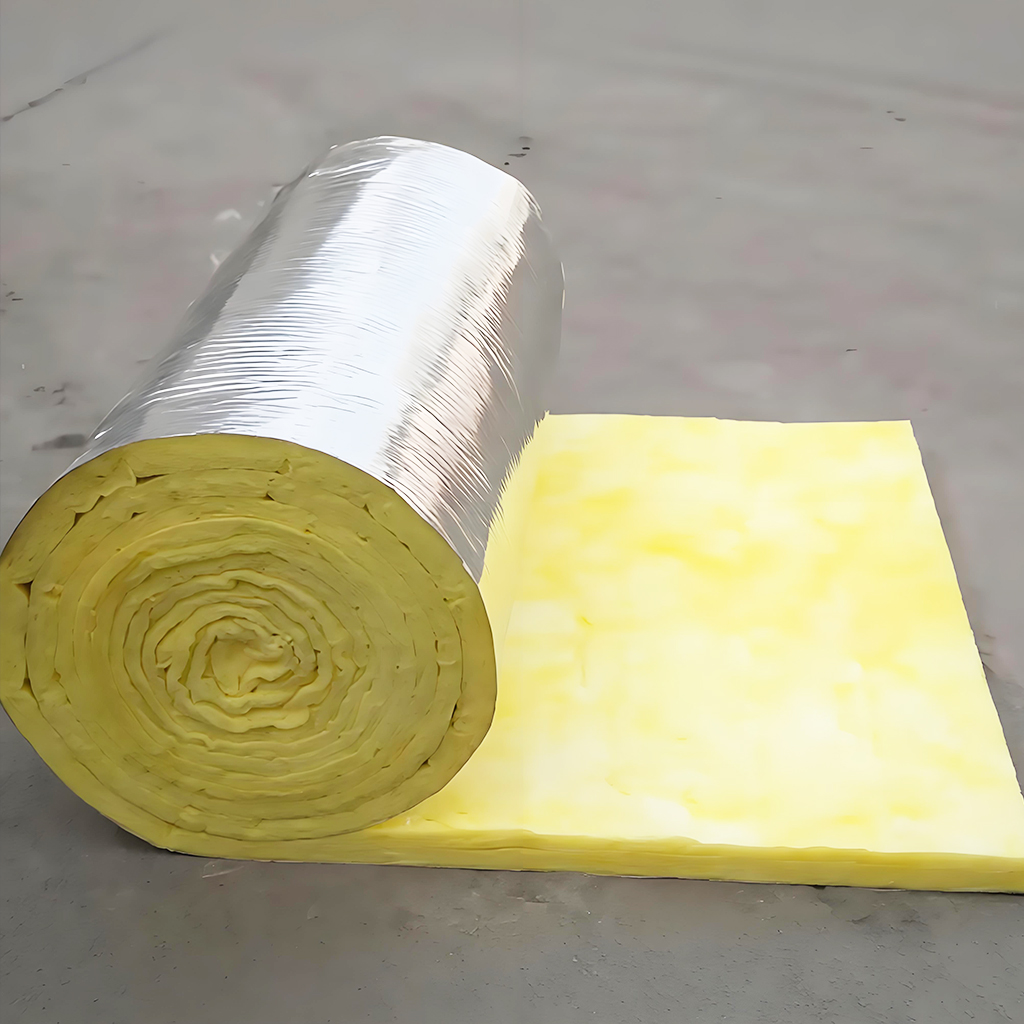
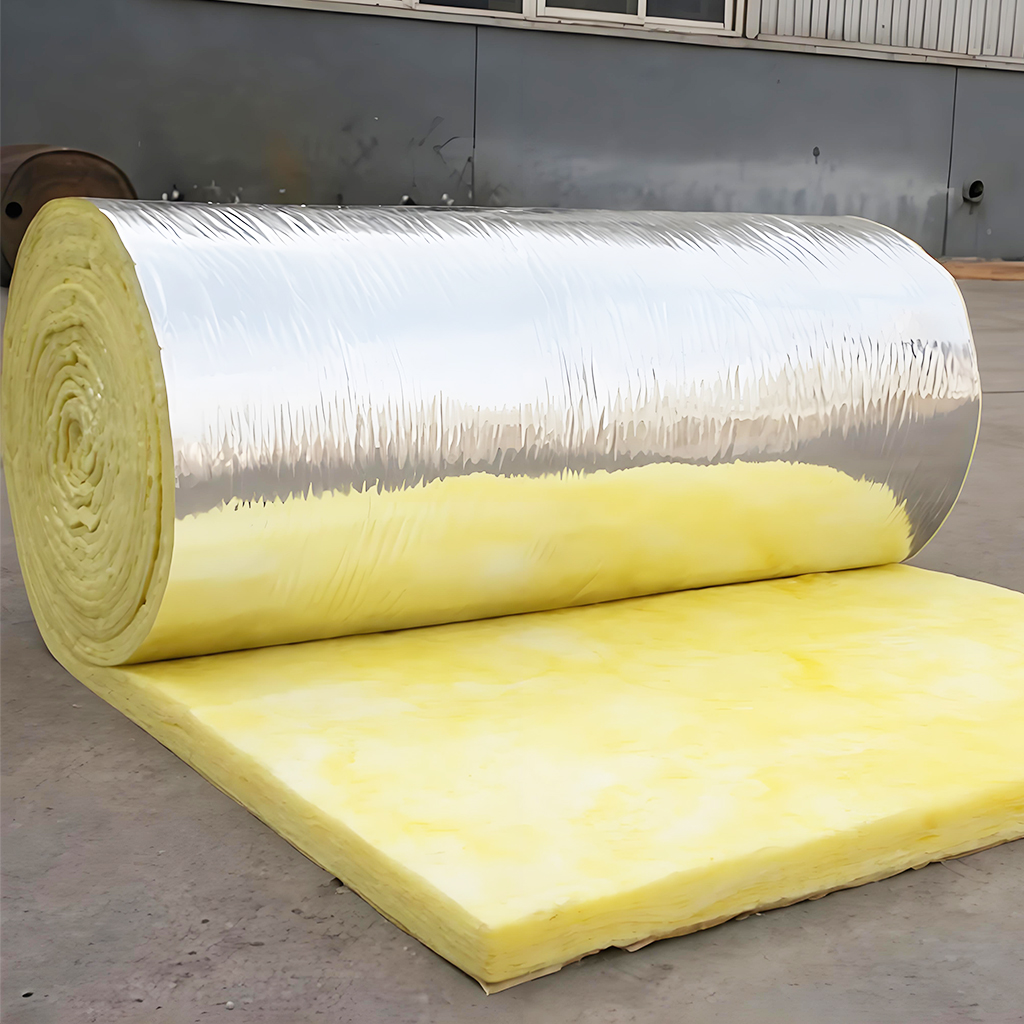
How Fibrous Insulation Provides Both Thermal and Acoustic Performance
The reason a single material can deliver both functions is that both functions depend on the same feature: a porous, open structure of fibers with a high proportion of trapped air. The two mechanisms, however, operate on different physical principles:
Thermal performance: trapped air resists conduction
Heat moves through a material primarily by conduction. In a fibrous insulation product, the solid material (glass or rock fiber) occupies only a small fraction of the volume; the remainder is air held in the inter-fiber voids. Air is a poor conductor of heat, so the more effectively the fiber structure prevents convective movement of that trapped air, the lower the thermal conductivity of the product. Glass wool at standard densities (12–48 kg/m³) achieves a declared thermal conductivity of 0.033–0.040 W/m·K, placing it among the most effective insulating materials per unit thickness. The result is an insulating layer whose thermal resistance is determined by thickness and density, independent of its acoustic function.
Acoustic performance: fibers dissipate sound energy
Sound is a pressure wave that propagates through air. When that wave enters a porous, fibrous structure, the air motion within the fibers generates friction and viscous losses at the fiber surfaces, converting acoustic energy into small amounts of heat. This energy dissipation is what makes the material absorb sound rather than reflect it. The effectiveness of this absorption depends on the fiber structure, the product density, and the thickness — factors that overlap with, but are not identical to, the factors that determine thermal conductivity.
The key point for specifiers is that the two performance functions are complementary, not competing. A acoustic wall insulation product does not sacrifice thermal performance to achieve acoustic performance, or vice versa. The same material delivers both, and the specification question is how to tune density and thickness to meet both targets efficiently.
Reading Acoustic Performance Ratings Correctly
Acoustic performance is described by several different metrics, and the one that matters depends on whether the wall is separating two spaces (sound insulation) or treating a single room (sound absorption). Confusing the two is a common specification error.
Sound absorption: Noise Reduction Coefficient (NRC)
For a single room, the relevant measure is how much sound the wall surface absorbs rather than reflects. This is expressed as the Noise Reduction Coefficient (NRC), calculated per ASTM C423 from sound absorption coefficients measured in a reverberation room per ISO 354. NRC is the average absorption coefficient at 250, 500, 1000, and 2000 Hz, on a scale from 0 (perfectly reflective) to 1 (perfectly absorptive). A fibrous acoustic wall insulation product at typical densities achieves an NRC in the range of 0.65–1.00 depending on density and thickness. Higher density and greater thickness generally increase absorption, particularly at lower frequencies.
Sound insulation: Sound Reduction Index (SRI / Rw)
For a wall separating two spaces, the relevant measure is how much sound the complete wall assembly blocks. This is expressed as the Sound Reduction Index (SRI in the US, Rw in Europe), measured per ISO 10140 series. Crucially, the SRI of a wall depends on the complete assembly — the mass of the leaves, the cavity, the insulation within the cavity, and the detailing — not on the insulation product alone. Mineral wool insulation in the cavity improves the SRI of a double-leaf wall by reducing the acoustic coupling between the leaves; the improvement is typically in the range of 3–8 dB depending on the wall construction, with diminishing returns above a certain cavity-fill density. Beyond that point, adding more insulation does not increase the SRI and may even reduce it if the cavity is fully bridged.
European rating: EN ISO 11654
In European specifications, sound absorbers are rated under EN ISO 11654 on an A–E scale based on the weighted sound absorption coefficient. This provides a single-class comparison between acoustic products and is the standard reference for specifying absorptive wall linings in commercial buildings.
Density: The Controlling Parameter for Acoustic Wall Insulation
Unlike thermal performance, which depends mainly on thickness, acoustic absorption depends strongly on density. For acoustic wall insulation applications, the products of interest are typically in the 32–64 kg/m³ density range for glass wool — higher than the 12–24 kg/m³ used for roof insulation, but well within the glass wool product family. In this density range, the fiber structure provides enough acoustic mass and internal friction to absorb sound effectively without the higher cost and handling weight of a dense rigid board.
The relationship is not linear, and the optimum density depends on the frequency range of the noise problem. Low-frequency noise (HVAC plant, traffic, machinery) is harder to absorb than mid- and high-frequency noise (speech, office activity), and controlling it typically requires greater thickness and density than a thin acoustic layer can provide. Specifiers should match the density and thickness to the dominant noise frequency rather than selecting a product on NRC alone.
Selecting Acoustic Wall Insulation by Building Type
The appropriate acoustic wall insulation specification varies with the building use, because the acoustic target and the dominant noise source differ:
Offices and meeting rooms: speech privacy and reverberation control are the priorities. Mineral wool wall insulation with an absorptive internal lining reduces reverberation and improves speech intelligibility. Moderate density (32–48 kg/m³) at 50–100 mm thickness is typically adequate.
Schools and lecture theatres: high background noise and reverberation degrade learning. Higher absorption and careful detailing at junctions are required. Denser products and greater thickness improve low-frequency absorption where needed.
Healthcare: patient rooms require both privacy (sound insulation between rooms) and low reverberation (absorption within rooms). The wall assembly must be specified for SRI between rooms, with absorptive treatment inside.
Hospitality and restaurants: high ambient noise from voices and music makes reverberation control essential for occupant comfort. Absorptive wall linings are the primary intervention.
Industrial partitions: noise from plant, machinery, or processes requires both high sound insulation (SRI of the assembly) and, where workers are present, absorptive treatment to reduce in-space noise levels. Mineral wool partitions with appropriate mass and cavity fill are standard.
Fire Safety and Acoustic Wall Insulation
Acoustic wall insulation in commercial and institutional buildings must meet the same fire classification requirements as any other envelope or partition insulation. Mineral wool products manufactured without organic binders achieve A1 classification under EN 13501-1 from their mineral composition alone — no fire-retardant additives required, and no degradation of the classification over the building's operating life. For partition walls that are required to provide a fire resistance rating, the insulation must be included in the tested wall assembly; verify that the specific product and thickness are part of the rated assembly before specifying.
The facing selection also affects fire performance. A foil or kraft facing changes the product configuration and may change the fire classification; the classification on the test certificate applies to the exact facing specification tested, and a different facing requires re-verification.
Combined Thermal and Acoustic Specification: Avoiding Over-Building
The main advantage of specifying acoustic wall insulation as a combined thermal-acoustic product is that it avoids over-building the wall. A common error is to specify a thick thermal insulation for energy code compliance, then add a separate acoustic layer for sound control, producing a wall thickness that exceeds what either requirement needs individually. A single mineral wool layer sized to the more demanding of the two targets typically satisfies both, reducing material cost, labor, and wall thickness.
The specification process should start by identifying the governing requirement — the U-value target from the energy code, or the SRI/NRC target from the acoustic brief — and selecting a product and thickness that meet it, then confirming that the same specification meets the secondary requirement. In most commercial wall applications, a single mineral wool layer of 50–100 mm at 32–64 kg/m³ satisfies both a reasonable U-value target and a good acoustic target simultaneously.
Installation Factors That Affect Acoustic Performance
The acoustic performance of a wall depends as much on the installation as on the product. Common errors that degrade the acoustic outcome include:
Acoustic bridging: rigid connections between leaves (through-wall studs, pipes, conduits) transmit sound directly across the partition, bypassing the insulation entirely. Use resilient channels or staggered studs for separating walls.
Gaps and compression: gaps at the perimeter or compression of the insulation at fixings create flanking paths and reduce both thermal and acoustic performance. The insulation should fill the cavity fully without bridging the leaves.
Perimeter sealing: all junctions with floors, ceilings, and adjacent walls must be sealed to prevent flanking transmission. Acoustic performance is only as good as the weakest detail.
FAQ
Q1: Can one insulation product provide both thermal and acoustic performance?
A: Yes. Fibrous mineral wool provides thermal resistance through trapped air (thermal conductivity 0.033–0.040 W/m·K for glass wool) and acoustic absorption through energy dissipation at the fiber surfaces. A single mineral wool layer of appropriate density and thickness can satisfy both a U-value target and an acoustic target, avoiding the cost and thickness of separate treatments.
Q2: What density is needed for acoustic wall insulation?
A: For glass wool acoustic wall insulation, products in the 32–64 kg/m³ range are typically used — higher than roof insulation densities but within the same product family. Higher density and greater thickness improve absorption, particularly at lower frequencies. Match the density and thickness to the dominant noise frequency rather than selecting on NRC alone.
Q3: Does adding more acoustic wall insulation always improve sound insulation between rooms?
A: Not necessarily. For a double-leaf separating wall, cavity insulation improves the Sound Reduction Index (SRI) by reducing acoustic coupling between leaves, typically by 3–8 dB depending on the construction. Beyond a certain cavity-fill density, additional insulation provides diminishing returns and can even reduce performance if it bridges the two leaves. The complete assembly — mass, cavity, and detailing — determines the SRI, not the insulation alone.
Q4: What is the difference between NRC and Sound Reduction Index for wall insulation?
A: NRC (per ASTM C423 / ISO 354) measures how much sound a surface absorbs within a room — relevant for reverberation control. Sound Reduction Index (SRI / Rw, per ISO 10140) measures how much sound a complete wall assembly blocks between two spaces — relevant for privacy and separation. They describe different functions, and a product strong in one is not automatically strong in the other; the wall assembly design determines the SRI.
Q5: Does the facing on acoustic wall insulation affect fire classification?
A: Yes. A fire classification under EN 13501-1 applies to the exact product configuration tested, including the facing. A foil or kraft facing may change the classification, and a different facing from the one on the test certificate requires re-verification. Unfaced or low-binder mineral wool products achieve A1 classification from their mineral composition without additives.
Conclusion
Acoustic wall insulation based on fibrous mineral wool is the most efficient way to deliver combined thermal and sound control in commercial and institutional buildings, because the same porous fiber structure provides thermal resistance through trapped air and acoustic absorption through energy dissipation. The specification should be driven by the governing requirement — the U-value target from the energy code or the acoustic target from the brief — with a single mineral wool layer of 50–100 mm at 32–64 kg/m³ typically satisfying both. Acoustic performance depends on the complete wall assembly and its installation detailing as much as on the product, so flanking paths, perimeter sealing, and cavity fill continuity must be specified alongside the insulation. Fire safety is met by A1-classified mineral wool products without additives, provided the exact facing and thickness match the tested configuration. Specifiers who treat thermal and acoustic performance as one combined requirement — rather than two sequential specifications — consistently achieve compliant, high-performing walls with lower installed cost and reduced wall thickness. Technical datasheets, acoustic and thermal calculation support, and product ratings for acoustic wall insulation are available from insulation manufacturers such as huashuoinsulation.com.
References
1. EN 13162:2012+A1:2015, "Thermal Insulation Products for Buildings — Factory Made Mineral Wool (MW) Products — Specification," European Committee for Standardization, Brussels.
2. ISO 6946:2017, "Building Components and Building Elements — Thermal Resistance and Thermal Transmittance — Calculation Methods," International Organization for Standardization, Geneva.
3. EN ISO 11654:1997, "Acoustics — Sound Absorbers for Use in Buildings — Rating of Sound Absorption," European Committee for Standardization, Brussels.
4. ASTM C423-17, "Standard Test Method for Sound Absorption and Sound Absorption Coefficients by the Reverberation Room Method," ASTM International, West Conshohocken, PA.
5. Cox, T.J. and D'Antonio, P. (2009). "Acoustic Absorbers and Diffusers: Theory, Design and Application." CRC Press / Spon Press, Abingdon, UK.